Money
Payroll you can show your working for.
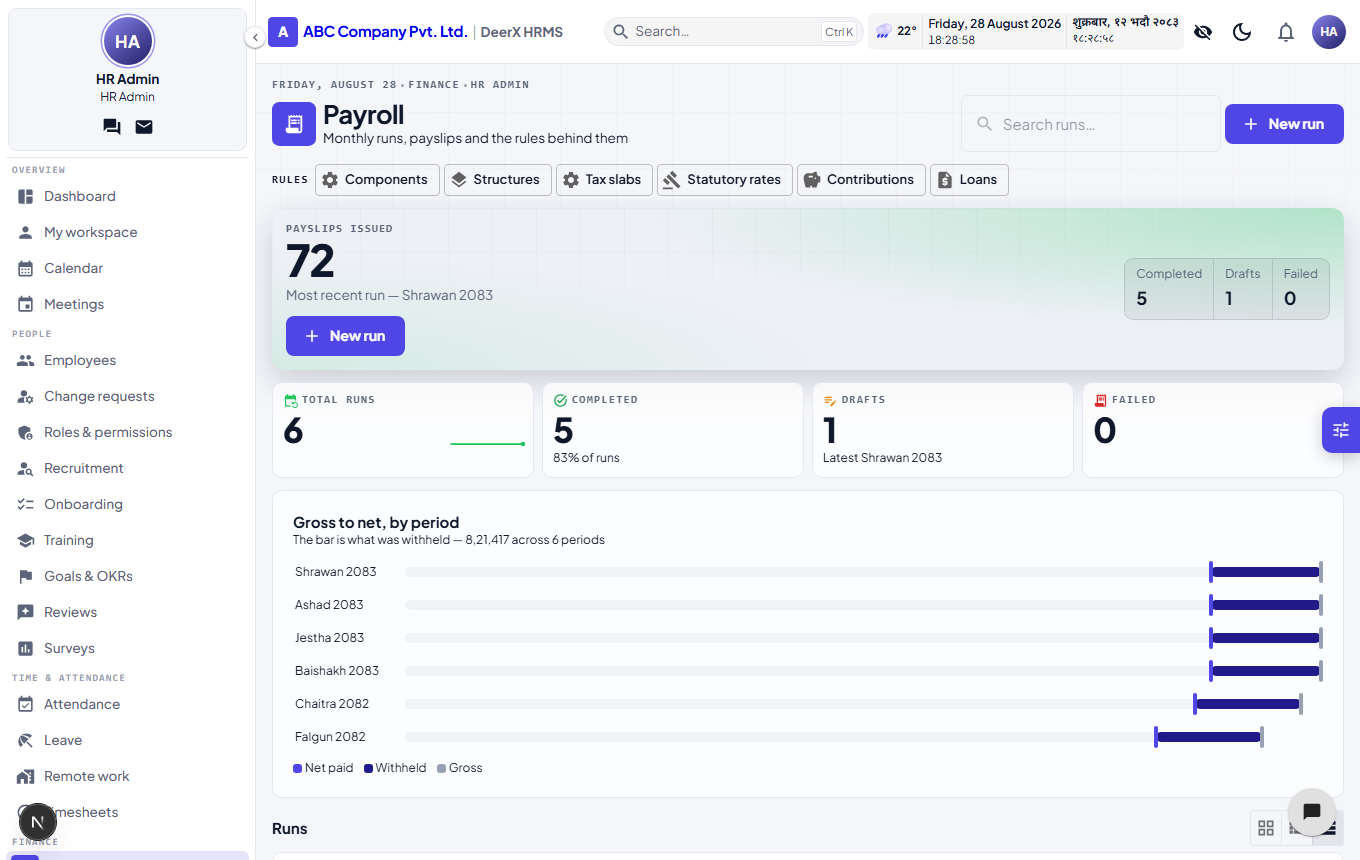
Payroll is a spreadsheet one person understands. When somebody asks why their tax changed, the answer takes an afternoon and rests on trusting that no formula was dragged one row too far.
01
Salary rules, statutory rates and tax slabs are configuration with effective dates. A rate corrected mid-year does not restate the payslips already issued — the difference between a correction and a rewrite of history.
02
Every payslip line says where it came from: a flat amount, a percentage of a named component, a formula, or a slab table. A run that cannot compute somebody stops and names them, rather than paying a number nobody chose.
03
The period is stored in the calendar the company keeps books in. On Bikram Sambat, Shrawan 2083 means 17 July to 16 August — and the days paid are the days the label claims.
What is in Money
Salary structures
Component sets assigned to people, effective-dated.
Formula engine
Sandboxed expressions with declared evaluation order.
Tax slabs
Per-fiscal-year, per-workspace, editable without a release.
Payroll runs
Draft, process, complete — with a lock at the end.
Payslips
Line-itemised, rendered to PDF, delivered to each employee.
Loans & advances
Recovered through payroll rather than tracked on the side.
Expense claims
Claim, approve, reimburse — traceable to the payslip line.
Billing
Plans, subscriptions and platform invoices for the operator.
Payments
Khalti, eSewa and manual proof-of-payment behind one interface.
What it does not do
Stated on purpose. A page that claims everything tells you nothing.
No money moves from here. Payroll produces the bank instruction; the bank moves the money, because a payout API that silently half-succeeds is worse than a file somebody uploads deliberately.
Tax slabs are configuration, not law. The Finance Act changes, and a product that hardcodes this year's bands is wrong every year after.
Keep reading